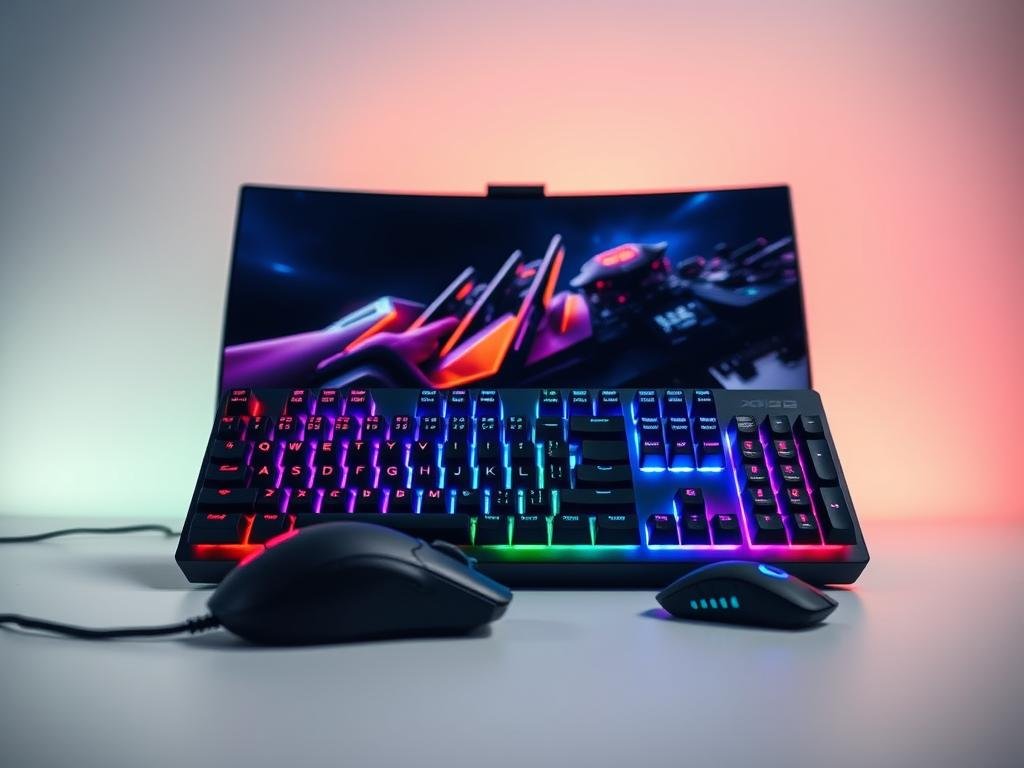

“The difference between the impossible and the possible lies in a person’s determination.” – Tommy Lasorda. Just like in sports, precision and speed define success in competitive play. Your tools must keep up with your ambition.
A well-tuned setup enhances reaction times and accuracy. Whether you’re a casual player or a pro, optimizing your gear ensures peak performance. It’s not just about looks—functionality matters just as much.
This guide walks you through a 17-step roadmap to transform your experience. From ergonomic comfort to PC Gamer’s 2025 performance benchmarks, every detail counts. Ready to elevate your play?
Understanding Gaming Keyboards
Not all input devices are created equal. The right choice impacts your *typing experience* and reaction speed. Whether you prefer tactile feedback or silent presses, the technology behind each key matters.
Mechanical vs. Membrane Keyboards
Mechanical keyboards use individual switches, like Cherry MX or Gateron, for precision. They last over *50 million keystrokes* and have a 2mm travel distance. This means faster actuation and better control.
Membrane keyboards rely on rubber domes, requiring 4mm of travel. They’re quieter but less durable. For competitive play, the difference in responsiveness is clear.
Key Components of a Gaming Keyboard
Inside every device, a PCB (printed circuit board) ensures signal accuracy. Stabilizers reduce wobble, while anti-ghosting matrices let you press multiple keys at once. These details define your *typing experience*.
Why Build Quality Matters
Aluminum frames, like those in Meetion models, prevent flex during intense sessions. Spill-resistant designs protect circuitry. Cheap materials wear out faster—investing in build quality saves money long-term.
Choosing the Right Gaming Keyboard
Latency, tactile feedback, and layout design define your playstyle. Whether you’re fragging enemies or executing combos, your hardware must keep pace. Here’s how to pick the ideal match.
Wired vs. Wireless: Latency and Reliability
Wired models dominate with a 1ms response time, critical for esports. Wireless alternatives using 2.4GHz hover near 8ms—Logitech’s LIGHTSPEED tech narrows the gap. Bluetooth (12ms) suits casual play but risks input lag.
| Connection Type | Latency | Best For |
|---|---|---|
| Wired (USB) | 1ms | Competitive FPS/MOBA |
| Wireless 2.4GHz | 8ms | Balanced performance |
| Bluetooth | 12ms | Casual use |
Switch Types: Linear, Tactile, and Clicky
Switches dictate feel and sound. Linear (e.g., Cherry MX Red) glide smoothly for rapid-fire shots. Tactile (Brown) offer a bump for typing accuracy. Clicky (Blue) provide audible feedback—ideal for MOBAs.
Dive deeper into mechanical keyboard switches to match your preference.
Layout Options: Full-Size, TKL, and Compact
Full-size layouts include numpads for MMO macros. Tenkeyless (TKL) trims the numpad for more mouse space. Compact (60%) fits LAN setups but sacrifices function keys. Prioritize N-key rollover for complex combos.
For FPS players, 60% layouts reduce clutter. RPG fans benefit from macro pads on full-size boards.
Unboxing and Initial Setup
First impressions matter—ensure every component meets expectations. High-end models like the Meetion MT68 often include extras like magnetic wrist rests and PBT keycap pullers. Start by verifying all items against the unboxing checklist.
Inspecting Your Keyboard and Accessories
Check for a detachable USB cable, alternate keycaps, and warranty cards. Premium brands may include tools for customization, such as switch pullers. Ensure no physical damage exists—flex the frame gently to test build quality.
Connecting via USB or Bluetooth
For wired setups, plug the USB cable directly into your PC. Wireless models with Bluetooth 5.1 offer dual-mode connection—pair via system settings or a dedicated dongle. Note: Wired mode reduces latency for competitive play.
| Setup Type | Steps | Best For |
|---|---|---|
| Wired | Connect USB, wait for driver auto-install | Esports, low latency |
| Wireless | Pair via Bluetooth or 2.4GHz receiver | Multi-device flexibility |
Driver Installation (If Required)
Some peripherals need manufacturer software like Razer Synapse. Download it from the official site, then disable Windows Game Mode to prevent conflicts. For tournaments, save profiles to onboard memory—dual-mode connectivity ensures compliance.
Configuring Key Bindings for Gaming
Pro players optimize every key press—here’s how you can too. Strategic rebinding reduces misclicks and speeds up execution. Whether you play FPS or MOBAs, tailored layouts give you a competitive edge.
Mapping Essential Game Commands
Prioritize frequently used actions like reloading or crouching. Bind them to easily accessible keys, such as side mouse buttons or thumb clusters. For example, CS:GO pros often assign grenades to G-keys for quick access.
Use Shift or Ctrl modifiers for secondary functions. This layers commands without overcrowding your layout. A Valorant player might bind Spike Plant to Ctrl+E to avoid accidental triggers.
Creating Multi-Action Macros
Macros automate complex sequences with one press. Software like Razer Synapse lets you record actions with 0.2ms intervals. Ideal for buy scripts in CS:GO or ability combos in MMOs.
| Game | Macro Use | Key Bind |
|---|---|---|
| Valorant | Jett Dash + Knife Swap | Mouse Side Button |
| World of Warcraft | Healing Rotation | F5 |
Disabling Accident-Prone Keys
The Windows key ruins clutch moments. Enable *tournament mode* (often FN+Esc) to lock it. Similarly, disable Caps Lock if it’s unused—features like these prevent costly mistakes.
Backup profiles to cloud storage for cross-device sync. This ensures consistency whether you’re at home or a LAN event.
Optimizing RGB Lighting
Dynamic RGB effects can transform your battlestation into a responsive command center. Beyond visual appeal, strategic lighting enhances your gaming experience through real-time feedback and immersion. Here’s how to fine-tune every glow and pulse.
Software Customization Tools
Manufacturer apps like Razer Synapse or Corsair iCUE unlock deep customization. Create per-key lighting zones to track MOBA cooldowns or highlight WASD clusters. For ambient synergy, Philips Hue Sync mirrors in-game colors across your room.
- Assign red backlighting to low-health alerts in Apex Legends.
- Export profiles as JSON files to share setups with teammates.
Syncing Lighting with Games
Games like Cyberpunk 2077 natively support RGB integration. Flashing strobes on damage or pulsating hues for ultimates keep you informed mid-fight. Third-party tools like Aurora Project add support for older titles.
Battery Saving Tips for Wireless Models
Cut brightness from 100% to 30% to triple wireless battery life. Schedule sleep timers during AFK periods via software. Disable animations for static colors—every milliwatt counts in marathon sessions.
“Lighting should serve gameplay, not distract from it. Prioritize function over flash in competitive titles.”
Adjusting Typing and Gaming Sensitivity
Precision control separates casual play from competitive dominance. Fine-tuning your device’s responsiveness ensures every press translates to in-game action. Here’s how to optimize actuation, polling, and anti-ghosting for flawless execution.
Actuation Point Calibration
Devices like the Wooting Two HE let you adjust actuation from 0.1mm to 4mm. Racing games benefit from 2mm travel for rapid shifts, while typing feels smoother at 1.5mm. The SteelSeries Apex Pro TKL (Gen3) takes it further with adjustable actuation points via Hall Effect switches.
Polling Rate Settings
Match your polling rate to your monitor’s refresh cycle. An 8000Hz setting syncs perfectly with 360Hz displays, cutting input lag. For wireless models, balance battery life by lowering rates during non-competitive use.
Anti-Ghosting and N-Key Rollover
Test N-key rollover at keyboardchecker.com to ensure simultaneous presses register. Disable debounce delay for faster double-taps in fighting games. *Pro tip*: Reduce sensitivity slightly to avoid accidental key presses during intense moments.
“Sensitivity tweaks should feel invisible—your hands should focus on play, not hardware.”
Personalizing Your Keyboard’s Aesthetics
Your device should reflect your style while enhancing performance. Beyond functionality, visual and tactile upgrades create a more enjoyable experience. Let’s explore how to tailor every detail to your preference.
Swapping Keycaps for Style and Feel
PBT keycaps outlast ABS with oil-resistant coatings. They stay matte even after months of use. For ergonomics, SA profiles (higher) suit wrist-heavy typists, while Cherry profiles (lower) reduce finger stretch.
Artisan ESC keys serve as tactile landmarks during intense sessions. Match colors to your setup or use contrasting hues for quick key identification.
Adding Custom Decals or Skins
3M vinyl skins protect frames without blocking switch LEDs. Apply them dry for bubble-free finishes. Brands like Meetion offer laser-etched designs that won’t peel during travel.
Pro tip: Use a hair dryer to stretch skins around curved edges for seamless coverage.
Choosing the Right Wrist Rest
Memory foam rests (like Meetion’s ergonomic models) adapt to your posture. Match the incline to your desk height:
| Desk Height | Recommended Angle |
|---|---|
| 29″ | 15° |
| 27″ | 10° |
Cleaning weekly with mild soap preserves the foam’s support. Gel alternatives suit cooler climates but lack adjustability.
“Aesthetic upgrades should complement—not compromise—your workflow. Prioritize comfort alongside visual appeal.”
Enhancing Comfort During Long Sessions
Long sessions demand smart ergonomics—your comfort impacts performance. Discomfort slows reflexes and strains muscles. Simple tweaks to posture, accessories, and workspace layout make hours feel like minutes.
Ergonomic Positioning Tips
NASA recommends a 25° elbow angle and a 2″ gap between your chair and the tray. This reduces shoulder tension. Pair with a gaming chair that supports lumbar curves.
Keep wrists flat to avoid carpal tunnel strain. A slight downward tilt (5–10°) promotes comfortable typing. Monitor height should align with eye level to prevent neck fatigue.
Reducing Finger Fatigue
O-rings dampen keystrokes, cutting bottom-out force by 30%. Follow the 20-20-20 rule: every 20 minutes, pause for 20 seconds to stretch fingers.
- Use a vertical mouse to prevent ulnar deviation.
- Monitor forearm temperature with IR sensors—overheating signals repetitive stress.
Managing Cable Clutter
Magnetic clips under desks route cables cleanly. Wireless features like Bluetooth 5.1 reduce tangles. For wired setups, braided sleeves bundle cords neatly.
“Ergonomics isn’t luxury—it’s necessity. Your body’s limits define your play’s limits.”
Software Deep Dive: Advanced Features
Mastering advanced software unlocks hidden potential in your setup. Beyond basic rebinding, tools like AutoHotkey enable cross-platform scripting. Whether you’re optimizing for esports or streaming, these features like profile switching and cloud backups streamline your workflow.
Profile Creation for Different Games
Tailor profiles per title for instant adaptability. For example:
- Fortnite: Assign weapon swaps to side buttons with per-mode DPI shifts.
- MMOs: Save rotation macros to function keys for raid readiness.
Most software lets you toggle profiles via hotkeys—no desktop switching mid-match.
On-the-Fly Macro Recording
Record complex sequences in real-time. Tools like Razer Synapse capture mouse and key inputs with 0.2ms precision. Use cases:
| Game | Macro Action | Time Saved |
|---|---|---|
| Valorant | Burst-fire recoil control | 0.5s/reload |
| WoW | Healing priority chain | 1.2s/cast |
AutoHotkey scripts extend functionality, like alt-tab prevention during cutscenes.
Cloud Sync for Settings Backup
Never reconfigure from scratch. AES-256 encryption protects macros during LAN travel. Sync via:
- QR codes for instant device pairing.
- Version control to undo corrupted updates.
“Cloud backups are tournament essentials—losing settings costs rounds.”
Troubleshooting Common Issues
Even the best gear can face hiccups—here’s how to solve them. From unresponsive keys to firmware bugs, quick fixes keep your setup running smoothly. Address these issues before they impact your performance.
Fixing Unresponsive Keys
Diagnose unresponsive keys with a multimeter continuity test. Dead switches often need replacement, but first, check for debris under the keycap. QMK firmware lets you recalibrate switches manually.
For oxidized USB-C connectors, swap in gold-plated replacements. Grounding issues? Isolate phantom inputs by testing on another device.
Resolving Software Conflicts
Software clashes (e.g., Razer Synapse vs. Corsair iCUE) cause erratic behavior. Boot in safe mode to disable conflicting processes. Clean installs often fix corrupted drivers.
Pro tip: Schedule driver updates during off-hours to avoid mid-game interruptions.
Updating Firmware
Outdated firmware risks compatibility and security gaps. Use BIOS recovery mode to roll back faulty updates. Always download firmware directly from the manufacturer’s site.
- Back up profiles before updating.
- Verify checksums to prevent corrupt installations.
“A glitch-free setup isn’t luck—it’s diligent maintenance. Stay ahead of issues to stay in control.”
Maintaining Your Gaming Keyboard
Keeping your device in top condition ensures consistent performance and longevity. Proper care prevents sticky keys, erratic inputs, and premature wear. A little maintenance goes a long way in preserving your investment.
Cleaning Keycaps and Switches
Dirt and oils accumulate over time, affecting key switches and tactile response. For deep cleaning:
- Remove keycaps monthly using a puller to avoid damage
- Use ESD-safe brushes to dislodge debris between switches
- Soak PBT caps in mild soapy water—ultrasonic cleaners work best for stubborn grime
For mechanical keyboard switches, compressed air clears dust without liquid risk. Avoid alcohol—it degrades plastic over time.
Preventing Dust and Liquid Damage
Accidents happen, but protection minimizes fallout. Follow these steps:
- Apply conformal coating to the PCB for splash resistance
- Use silicone dust covers during storage or travel
- Position drinks away from your workspace—opt for spill-proof containers
Check this guide for detailed repair steps if liquid exposure occurs.
When to Consider Switch Lubing
Lubrication smooths keystrokes and reduces noise. Ideal candidates:
- Scratchy or inconsistent switches (apply Krytox 205g0 every 6 months)
- Stabilizers producing rattle—lube the wire and housing
- New switches needing break-in period refinement
Note: Over-lubing causes sluggish response—use sparingly on tactile switches.
“Maintenance isn’t optional—it’s the difference between a season and a lifetime of peak performance.”
Boosting Performance for Competitive Play
Every millisecond counts when competing at the highest levels—here’s how to shave off delays. Pro players optimize hardware and software to eliminate bottlenecks. Whether you’re grinding ranked matches or preparing for tournaments, these tweaks deliver tangible gains.
Minimizing Input Lag
Nvidia Reflex slashes system latency by 30% when paired with optimized peripherals. Disable USB selective suspend in Windows power settings to prevent intermittent delays. For wired setups, overclock USB controllers via BIOS for 0.5ms gains.
Measure latency with tools like HIDUSBF or KeyboardTest. Tournament-approved firmware ensures stability. Anti-ghosting matrices and N-key rollover guarantee every press registers—critical for combo-heavy games.
| Optimization | Latency Reduction | Tool |
|---|---|---|
| Nvidia Reflex | 30% | GPU Software |
| USB Overclocking | 0.5ms | BIOS |
| Firmware Update | Varies | Manufacturer Site |
Optimal Settings for FPS/MOBA Games
Bind jump-throw actions in CS:GO to -attack; -jump for consistency. MOBA players should assign ability combos to macro keys with 0.2ms intervals. Reduce polling rates to 500Hz for older titles—higher rates strain CPUs unnecessarily.
For competitive play, disable Windows Game Mode to avoid background throttling. Prioritize wired connections for LAN events.
Benchmarking Keyboard Response Times
Test switches (e.g., Cherry MX Speed) for actuation consistency. Mechanical variants like SteelSeries OmniPoint adjust dynamically—ideal for rapid taps. Use high-speed cameras to validate press-to-screen delays.
“Latency isn’t just a number—it’s the barrier between your skill and its execution.”
- Calibrate actuation points for your playstyle (1.0mm for FPS, 2.0mm for RPGs).
- Update firmware quarterly to patch latency bugs.
- Store profiles onboard to avoid software overhead.
Integrating with Other Gaming Peripherals
Your battle station’s true potential unlocks when devices work in harmony. Syncing gaming mouse sensitivity, headset cues, and RGB lighting creates immersive feedback loops. Top-tier software solutions bridge these elements into a single ecosystem.
Syncing Lighting with Mouse and Headset
Razer Chroma Studio syncs 16.8 million colors across 150+ devices. Match your gaming mouse pulsations to keyboard reactive effects—red flashes for low health, blue pulses for ultimates. Headsets with mic input can trigger audio visualizers that ripple across all gear.
| Peripheral | Sync Feature | Competitive Benefit |
|---|---|---|
| Mouse | DPI stage lighting | Visual sensitivity confirmation |
| Headset | Killstreak strobes | Tactical alert without HUD checks |
| Keyboard | Cooldown progress bars | Ability timing precision |
Unified Software Solutions
Logitech G HUB centralizes control for mice, keyboards, and Stream Decks. Create device-specific profiles that auto-switch when launching games. Features like Elgato integration let you trigger lighting scenes or macro chains with one Stream Deck button.
“Unified control platforms reduce cognitive load—your focus stays on the game, not device management.”
Cross-Device Macro Sharing
Build macros that span peripherals—a single press can:
- Adjust mouse DPI while shifting keyboard actuation points
- Activate sniper mode (dim lights, lower sensitivity, mute mic)
- Sync MMO rotation alerts across mouse LEDs and keyboard underglow
Cloud backups ensure these complex chains stay intact during LAN events or system upgrades.
Upgrading Your Setup Over Time
Technology evolves—your gear should too. Peak performance demands periodic updates as components wear or new innovations emerge. Strategic upgrades keep your mechanical keyboard competitive without full replacements.
When to Replace Switches
Monitor switch performance with tools like Switch Hitter. Replace them if actuation variance exceeds 5% or keys feel inconsistent. Kailh Box switches offer IP56 dust/water resistance for harsh environments—ideal for LAN events or shared spaces.
Consider frankenswitches like Holy Pandas for customized tactile feedback. These combine stems and housings from different models for unique feels. Test them in hot-swappable boards before permanent installation.
Adding Programmable Macro Pads
Expand functionality with devices like the Elgato Stream Deck XL. Its 32 keys handle complex customization, from chat shortcuts to audio controls. USB-C connectivity ensures low latency for real-time commands.
Layer macros across profiles for different games or apps. Sync lighting with your main device for visual feedback during streams or tournaments.
Exploring Hot-Swappable Options
Hot-swap sockets let you test switch options without soldering. Boards with QMK/VIA compatibility support firmware tweaks for wireless retrofits. This future-proofs your mechanical keyboard as new switch types launch.
| Upgrade | Benefit | Ideal For |
|---|---|---|
| Hot-Swap PCB | Switch experimentation | Enthusiasts |
| Macro Pad | Extra commands | Streamers |
| Wireless Module | Cable-free use | LAN players |
“Upgrades should solve specific pain points—don’t fix what isn’t broken.”
Security and Privacy Considerations
Your privacy matters as much as your performance—don’t overlook security. Modern peripherals often collect usage data, from keystroke patterns to macro preferences. Proactive measures ensure your setup remains both powerful and protected.
Disabling Data-Collecting Features
Many software suites, like Razer Synapse, track usage analytics by default. Block these via firewall rules or opt for open-source tools like Via Configurator. Always review permissions—disable mic or webcam access if unused.
Secure Macro Storage
Macros containing sensitive commands (e.g., login sequences) need encryption. Use 7-Zip with AES-256 to lock files. For wireless security risks, air-gapped profiles prevent remote exploits.
Vendor Software Trustworthiness
Not all software is equal. Prioritize GDPR-compliant vendors like EU-based brands. Audit EULAs for data-sharing clauses—some features may transmit usage logs to third parties.
“Assume every device is a data endpoint. Encryption and permissions are your first line of defense.”
Conclusion: Elevate Your Gaming Experience
Peak performance hinges on balancing speed, comfort, and durability. Optimized actuation and latency give you the edge in clutch moments, while premium switches ensure consistency over millions of keystrokes.
Test adjustments with tools like Kovaak 2.0 to refine muscle memory. Emerging tech, like analog optical switches and AI-driven macros, will redefine precision—stay ahead by iterating often.
Remember: A gaming keyboard is only as good as its synergy with your health. Prioritize ergonomics to sustain long-term dominance. Now, go claim your victories.