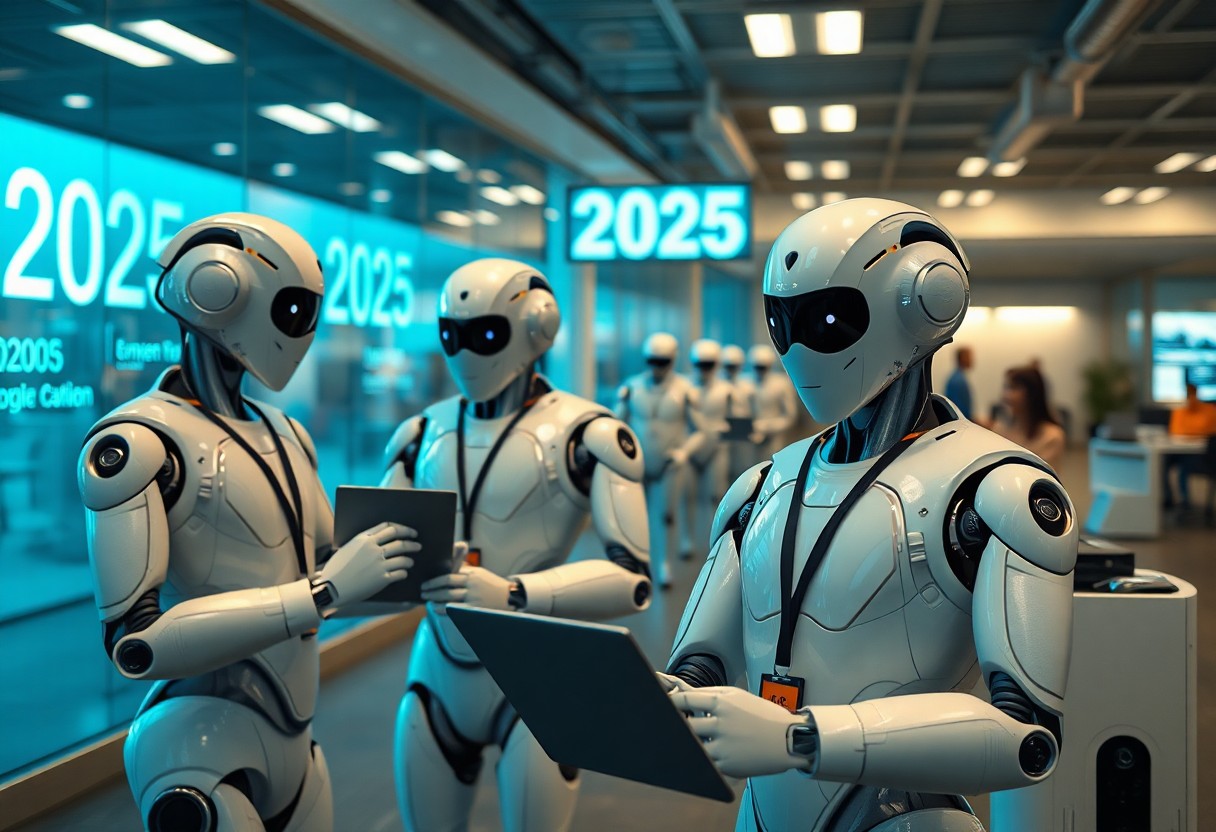

Over the next year, humanoid robots will begin entering real workplaces, not as prototypes but as functional team members. You will see them performing repetitive or physically demanding tasks in warehouses, factories, and logistics centers. While the shift brings efficiency gains and reduced injury risks, it also raises concerns about job displacement and workplace adaptation.
The Mechanical Dawn of 2025
You’re stepping into a year where humanoid robots are no longer prototypes but functional coworkers. By 2025, companies across logistics, manufacturing, and healthcare are integrating these machines into daily operations. Their presence isn’t about replacing you-it’s about handling tasks too repetitive or physically taxing for humans.
Projected Deployment Phases
Initial rollouts will focus on controlled environments like warehouses and assembly lines. You’ll see small fleets of robots performing predictable, rule-based tasks under human supervision. These early phases prioritize safety and system reliability before expanding into more dynamic settings.
Refinement of Bipedal Locomotion
Engineers have drastically improved how these robots move. You’ll notice smoother walking patterns and better balance on uneven surfaces. Advanced sensor fusion and real-time joint control now allow them to navigate stairs and crowded spaces with minimal risk of falling.
One key breakthrough lies in adaptive gait algorithms trained on millions of real-world steps. You’re not just seeing mimicked human motion-these systems learn how to shift weight, recover from stumbles, and adjust stride on the fly. That level of dynamic stability makes integration into human workspaces far more practical and safe.
Operational Spheres of Influence
You’re already seeing humanoid robots move beyond prototypes into real workplace roles. Their impact spans industries where human-like mobility and dexterity are important for interacting with existing infrastructure. These machines operate in environments built for people, giving them an edge over traditional automation.
Manufacturers and logistics firms are piloting deployments that reduce physical strain on workers while maintaining operational continuity. You’re not replacing humans-you’re redefining collaboration. These robots handle repetitive or strenuous tasks, freeing you to focus on oversight and complex problem-solving.
Logistics and Inventory Management
Warehouses are adopting humanoid robots to streamline picking, sorting, and restocking in spaces not redesigned for automation. You benefit from their ability to navigate narrow aisles and use standard shelving, reducing downtime and retrofitting costs.
These robots work alongside you during peak cycles, cutting error rates and accelerating fulfillment. Their sensors and AI adapt to inventory changes in real time, ensuring accuracy without slowing down operations.
Assembly Line Precision Tasks
On production floors, humanoid robots perform high-precision tasks requiring fine motor control, such as inserting small components or applying exact torque. You gain consistency in output, especially during long shifts when human fatigue sets in.
Equipped with vision systems and tactile feedback, they maintain quality standards across thousands of cycles. You retain control over final inspection while offloading repetitive motions that lead to workplace injuries.
These robots integrate into existing assembly lines without major reconfiguration. You can reprogram them for different models or tasks, making them adaptable assets during product changeovers. Their human-scale form allows them to use the same tools and stations you already rely on, minimizing disruption.
The Logic of Machine Integration
Integration of humanoid robots into workplaces follows a clear operational rationale. You’re not replacing human workers en masse but filling roles where repetitive, physically taxing tasks reduce productivity. These machines function best in structured environments with predictable workflows.
Manufacturers design these robots to complement existing teams. You’ll see them handling material transport or equipment staging, freeing skilled staff for higher-value responsibilities. Their deployment isn’t about automation at any cost-it’s strategic augmentation grounded in real workflow data.
Safety Protocols in Proximity
Safety remains a top concern when humans and robots share workspace. You must ensure each unit has real-time sensor feedback and emergency stop responsiveness within milliseconds. Collision avoidance systems use LiDAR and depth sensing to maintain safe distances dynamically.
Robots are programmed to operate at reduced speeds near personnel. You’ll notice they automatically power down limbs when unexpected contact is detected, minimizing injury risk. These protocols aren’t optional-they’re embedded in both hardware and control software by design.
Operational Efficiency Metrics
Efficiency gains are measurable from day one. You can track output increases through cycle time reductions and error rate declines in repetitive tasks. Some facilities report up to 30% improvement in task completion speed with consistent robot uptime.
Downtime analysis shows humanoid units require less maintenance than expected. You’ll find their performance curves stabilize quickly after initial deployment, delivering predictable throughput without fatigue-related drops.
Operational efficiency isn’t just about speed-it’s consistency. You gain value through reduced variability in task execution, fewer workplace injuries, and lower long-term labor strain. These metrics compound over time, making the business case stronger with each quarter of operation.
The Economic Imperative
Humanoid robots are no longer science fiction-they’re becoming a financial necessity. With labor costs rising and productivity demands increasing, companies must adapt or fall behind. Businesses that delay adoption risk losing ground to competitors who streamline operations with synthetic workers.
You’re already seeing early deployments in logistics and manufacturing, where uptime and precision matter most. These machines don’t take breaks, negotiate salaries, or file workers’ comp claims. That reliability translates directly into lower operational risk and higher output over time.
Addressing Global Labor Shortages
Many industries face a stark reality: there simply aren’t enough people to fill open roles. From warehousing to elder care, labor gaps are disrupting supply chains and limiting growth. You’re operating in a world where robots aren’t replacing workers-they’re stepping in where no workers exist.
Regions with aging populations or declining birth rates are feeling the pressure most. Humanoid robots offer a scalable solution, working alongside humans to maintain service levels. They’re not a luxury-they’re a response to demographic inevitability.
Long-Term ROI of Synthetic Labor
Initial robot investments look steep, but maintenance and energy costs are far below human payroll over a decade. You’ll see savings compound as software improves and deployment scales. A single robot can work 24/7 without benefits, overtime, or turnover.
Unlike traditional automation, humanoids adapt to existing workspaces without costly reengineering. You’re not just cutting costs-you’re building a more agile workforce. That flexibility is where the real financial advantage lies.
Over time, the intelligence embedded in these machines grows through updates and shared learning networks. You’re not buying hardware-you’re investing in a system that gets smarter and more efficient every month. This continuous improvement means your return isn’t fixed; it expands as the technology evolves.
The Neural Core
Your robot’s brain isn’t a single chip but a distributed network mimicking human neural pathways. This architecture enables real-time adaptation, letting machines learn from workplace interactions without constant reprogramming. What sets it apart is continuous self-optimization, improving performance with every task.
Engineers have embedded fail-safes directly into the core logic. If anomalies occur, the system isolates issues autonomously. This self-diagnosis reduces downtime and prevents cascading errors, making operations safer and more reliable than earlier automation models.
Sensory Perception and Environment Mapping
Sensors in the robot’s frame capture depth, temperature, sound, and motion simultaneously. You’ll notice how precisely it identifies obstacles or changes in lighting, adjusting movement in milliseconds. This fusion creates a live 3D map of its surroundings.
Unlike older models that relied on preloaded blueprints, today’s systems build maps dynamically. Even in cluttered offices or dimly lit warehouses, accuracy remains high enough to avoid collisions while navigating around people and equipment.
Decision-Making via Integrated AI
AI processes sensory data and task goals to choose actions without human input. You’re trusting it to prioritize safety when a forklift crosses its path, or to pause a delivery if someone blocks its route. These aren’t scripted responses-they’re context-aware judgments.
Each decision is logged and analyzed for future refinement. Over time, the robot adapts to your team’s rhythms, like recognizing peak hours or preferred workflows. This learning loop makes interactions feel less mechanical and more intuitive.
Behind every choice is a multi-layered AI model trained on millions of real-world scenarios. It weighs risk, efficiency, and human safety in parallel, simulating outcomes before acting. The most advanced versions even predict human intent-like stepping back when you reach for a shared tool-making collaboration feel natural, not forced. This isn’t autonomy for spectacle; it’s engineered precision with accountability built in.
To wrap up
Hence, humanoid robots are set to enter workplaces in 2025, not as sci-fi fantasies but as practical tools designed to assist with repetitive or physically demanding tasks. You will see them in warehouses, manufacturing units, and logistics centers, working alongside humans to improve efficiency and safety.
These machines learn from real-world interactions, adapting to environments over time. You should expect gradual integration, not overnight transformation-robotic coworkers will complement your efforts, not replace them, reshaping how work gets done with precision and consistency.